Showing posts with label Teaching English in Ulsan. Show all posts

Wednesday, April 29, 2015

Medical Check: Initiation Rite of the English Teacher in Ulsan

When most people hear the words medical check, they might think of something like a sports physical in the States. A nurse takes your weight and height. A doctor listens to your lungs and heart through a stethoscope. Your blood pressure is checked. Maybe there is a urine or blood test, but the list seems reasonable and overall non-intrusive. In Korea, non-intrusive is not a word I would use to describe what happens during a medical check.

For what made my third medical check, I went alone. I had returned to my former place of employment in Ulsan, and I had confidence in my ability to go to the hospital.

Easy.

Right?

Forgetting my previous experience in Ulsan, I had a preconceived notion that all Korean hospitals would be as foreigner friendly as the one in Gwangan, Busan. A place where the signs are in English, Russian, and Korean, and there is an information help desk on every floor. If someone doesn’t speak English? No problem. Call the on-site translator. Needless to say, I was in for a bit of a shock.
When I walked in the front doors at “Good Morning Hospital” (Yes, the sign was in English.), past the patients outside on their smoke breaks, I stopped and looked around. Where was the person who greets you when you walk in the door and tells you where to go and what to do if you have no idea? Where were the signs in English? The only English, foreign-friendly thing was the name of the hospital plastered on the outside of the building.

After so many times of feeling lost and overwhelmed, I have finally started to be able to process it. I no longer get worked up to a point of tears … when I am well-rested and well, anyway. Granted, I was neither sick, nor tired, nor rushed.

I took a deep breath.

Without a help desk, my option was to go to the hospital registration desk. I knew based on previous experience with hospitals and banks and anywhere with a line that I should take a number, if I wanted to get to the counter. I walked promptly to the machine that spits out numbers, took a number, and sat down to watch the digital numbers click up to mine. Only, for some reason, no one else decided to take a number, and while mine was only supposed to be two people away, I had to wait for the onslaught of people who had not taken a number to walk up to the desk and to get help. I was stunned. This was a-typical Korea from what I knew in Busan where people line up single-file on the busiest subway platform to get on a semi-crowded subway car. I almost decided that I was going to have to be pushy about things, but then my number came up. When I went up to the counter, I said in clear, concise English, “I need a medical check.” The woman looked at me with a blank stare and said some things in Korean.

It was in this hospital full of Koreans who did not speak English that I recognized something essential for life here in Ulsan.

I need to learn more Korean.

While I have day to day Korean which will help me with practical matters of finding what I need in a supermarket or ordering food or paying for things, I know zero Korean for hospitals. Somehow I fumbled enough that the supervisor of the woman I was trying to talk to came over, and said, “What is wrong? Where are you sick?”

“Nowhere. I am not sick. I need a medical check.”

“Huh? Uh.You need third floor.”

When I got to the third floor, I asked a nurse to point me toward the area for medical checks. I knew I was in the right place when I saw sample forms under the glass on tables, but the fillable forms were nowhere to be found. Just like the entry to the hospital, everything was different. In Busan my coworker showed me to a stack of forms, I filled one out, and then she handed it to the nurse. What did I expect? Different city, different hospital, different procedures.

I finally sorted out that I should go to the desk and ask for a form.

After filling out the form and handing it over, I was officially in the system and getting a medical check. The women said, “Pay, first floor (where I had just come from). Blood and urine, second floor. Then come back.”

Admittedly a bit baffled by the inefficiency of this payment system, again, compared to my hospital in Busan. I went down to the first floor, and learning from my previous experience, I did not take a number. I walked up to an open counter space and handed over my boss’ credit card to pay for the medical check.

Then I headed up to the second floor for “blood and urine”. When I came out of the stairwell, there were no immediate clues as to where to go, and no one around to ask. Once again I felt lost and helpless. The only room labeled in English was physical therapy. Obviously, I did not need to go there, but I thought, if I looked lost and helpless enough, someone would help.

Boy was I wrong.

I saw a single nurse in the two minutes I spend wandering around. When I took a step toward her to try and figure out where I needed to go, she glanced at me for a second before realizing that I was going to attempt to speak English at her. Rather than stop and deal with what might be slightly awkward, she put her head down and scurried off.

This made me laugh inside. I completely understand. If you are scared to do something, i.e. speak a language, you do your best to ignore it. My students attempt this all the time, and it is possible that I might do the same thing in her position. 

Then, I saw it. A man holding the crook of his elbow, a tell-tale sign that he had got blood drawn. I walked in the direction he came from.

When I stepped into the “blood and urine” room and handed my paperwork to the first nurse, she immediately asked me in Korean if I speak Korean. I told her a bit. She acknowledged what I said, grabbed a Dixie cup, wrote my information on it, drew a line, and said, “Urine. Here,” while pointing at the line. No lid. No rules. No nothing. Then she directed me to the restroom around the corner. I grabbed the cup and all my things, and while hoping that I had enough urine to fill the cup to the line, I also wondered how they possibly think this is an accurate test. Anyone could do anything to their urine in that multi-stalled restroom.

After successfully (and barely) reaching the urine line, I returned with my cup and stuck it in the appropriate tray, a stainless steel hospital tray, without anything to stop the cups from sliding around. I would hate to be the person that carried that tray full of random people’s urine cups.

Knowing what was coming next, I took off my jacket and sat down so the nurse could take my blood. The nurse kind of directed me through the typical process, mostly in Korean and gestures, band on arm, hand in fist, me looking away from the place where a needle entered my tender inner elbow vein. The only English word she used through the gestures and slow, completely incomprehensible (to me) Korean was the word “blood”, a word I know in Korean. After she finished drawing my blood, she gave me a cotton swab, gestured to me to hold it on the puncture wound for “five minutes”. I did as I was told, put pressure on my puncture wound, and went to go sit in the hall. 

Even though I was less than two meters from her, I was out of sight. Almost immediately after I left the room, she started laughing about the situation.  She said something something in Korean, “Urine. Blood,” and then laughed at the scenario. Yes, this is a story to tell people. I thought it was amusing that she got such a kick out of how ridiculous the whole situation had become. 

Finally, after my five minutes were up, I headed back up to third floor.

I was adopted immediately by a nurse who did not speak much English but was incredibly caring and considerate. Each step of the way she guided me, sticking to my side, and making sure I felt safe and secure despite my lack of Korean. First she showed me to the changing room, directing me to remove everything on top through gestures. When I came out of the changing room, she waved me over to the eye exam where I got to show off my knowledge of the words “left” and “right” in Korean. Then it was on to the color-blindness test that I am always nervous I will screw up – colors blend! After that, it was a short scoot over to the blood pressure machine, which is always tricky because of the stress of not knowing what’s going on language wise. I cannot ever tell if my blood pressure is higher than normal because I have been ingesting too much salt or because of the slight stress of the situation. Next, on to measuring my bust line – this is confirmed by all foreign women, but none of us understand what it is all about. Height and weight followed that brief awkwardness. We then went into a private room where I did a listening exam. Hand gestures and noises communicated that when I hear a beep, I should click the button. When I felt I had failed the listening exam, we went to a different, closet-like room for an EKG scan. She had me lay down on the gurney and attached strange little suction cups around my heart. For some reason the nurse could not get a good reading, and she nervously took forever and kept apologizing. Finally, it was time for this caring nurse to pass me on to another woman for the chest/lung x-ray. The entire time, my nurse had not spoken three words of English to me. When she tried to pass me off, her proximity to me (she made sure her whole arm touched mine) and my lack of Korean, did not allow me to understand that she was in fact moving on to the next patient. Finally, she gently pushed me toward the other nurse and said quietly, “Say your name.” Then she was gone.

The next nurse was a lot more laid back and less concerned that I understood what was happening. She quickly took my chest x-ray to confirm that I was tuberculosis free. Then she set me free. I was not sure what to do next. Was I done? I checked in at the main desk to confirm. My little nurse was nowhere to be found. I really wanted to thank her for being amazing.

After confirming that I was finished, I went back to the dressing room. The door was closed, so I waited, assuming that it was busy. An older woman walked by me and walked straight into the changing room. Her daughter said, “Come on! Together!” But her mom said, “No, no, no,” in Korean. Needless to say, I waited, telling the daughter about my confusion with the dressing room while we waited for her mom to change.


When I changed, I realized the whole ordeal was done. In less than an hour, I had been put through a series of challenges and came out in the end, no tears of frustration had been shed. I was finished. It was time to treat myself to lunch and go to work. 

Monday, August 29, 2011

Art class in Ulsan: Eric Carle Style books

Surprisingly, the end of the Summer Art Class came faster than I expected.

Halfway through the class, the girls asked if they were JUST making a book. They had seen the work of the Winter Art Class and were a bit disappointed by how few projects we were tackling, but as they began to see their stories and books take shape, all their reservations disappeared.

The girls did an excellent job, especially considering the lag in the middle of the course, when they weren't quite sure what they were working toward. During this class, I wanted to avoid giving too much direction, so I didn't have a finished book for the students to look at, at all. In retrospect a bit more direction, perhaps with an "empty" book, might have been a happy middle ground. It would have provided motivation, but it also might have taken away the surprise at the end!

After much work in class, and hours spent at home binding the books, the Eric Carle style, illustrated books are finished!

Here are the results:


Lena's book: Caterpillar's Story
One day there lived a caterpillar. The caterpillar wanted to be a butterfly.
So the caterpillar ate many leaves.
But the caterpillar just got bigger and bigger.
The caterpillar was sad.
So, the caterpillar visited a butterfly. The caterpillar asked, and the butterfly answered.
"Go to the branch." The caterpillar listened. She went to the branch.
At last the caterpillar changed into a butterfly.
About the author.


Emma's book: The Ladybug's Adventure

One day, the ladybug lived in a leaf, but the ladybug didn't eat anything. So the ladybug was hungry, and she found some food with friends.
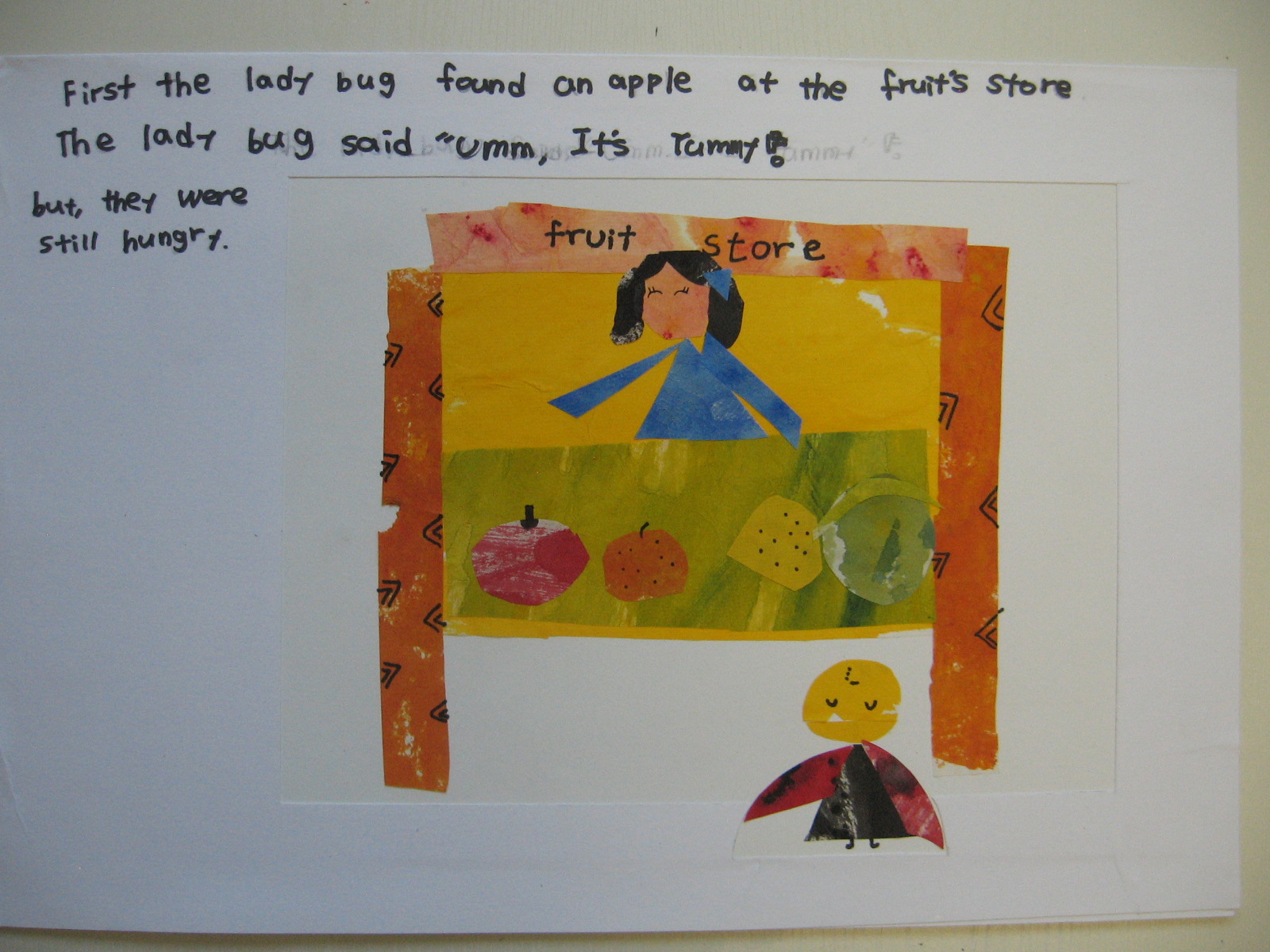
First the ladybug found an apple at the fruit store. The ladybug said, "Umm ... It's yummy!" but they were still hungry.
The ladybugs found a leaf in the woods. "Yuck!" The leaf was so bad!


And the leaf was next to the honey. "Wow, this is sweet!" They ate the honey and ate snacks too.


So the ladybug was full.
The ladybug said, "Oh! I am a happy ladybug!"
About the author.


Ana's book: Bunny Has Many Friends

One day, there was a bunny. The bunny didn't have friends and the bunny wanted friends.
But, it had only one friend. It was a squirrel. One day the bunny visited the bird's house.
The bunny said to the bird, "I want to be friends with you." So the bird said, "I don't want to be your friend because you can't fly."
So, the bunny was sad, but the bunny didn't cry.
And the bunny went to the squirrel's house. "Hello, squirrel. I don't have any friends."
The bunny was very sad, so the bunny wept.
The bunny grew, and now the bunny is a rabbit, so now the bunny has four friends.
Two squirrels and two birds. The rabbit was so happy!
About the author.

Friday, August 12, 2011

Art class in Ulsan: Eric Carle Style Illustrations

As stated previously, Korean students study ALL the time. Even during break they go to academy or sign up for extra classes at their school. For me this has resulted in the wonderful benefit of an art class. (See Art class in Ulsan for pictures and information about the winter art class with four boys.)

The summer art class has taken a different turn entirely. This is partly due to higher expectations of the students involved and partly due to their longer attention spans and increased patience. What started as a seemingly simple idea to create books, has evolved into a full out course on Eric Carle style illustrations.

With the help of Eric Carle's website and a slideshow on his books, I introduced my students to the concept of creating illustrations and making stories in the style of Eric Carle. We did not have access to his actual books. Yet it all worked out for the best.

Based on Carle's illustrations, I had the students brainstorm and discuss what they thought the stories were about. I discovered that this opened a door to the creative process. They couldn't copy the stories because the stories weren't there to copy! Many students, especially studious Korean girls, want to do everything "perfectly", but in art nothing is right or wrong. Not having an "answer" available created a bit of confusion at first, but they have begun an awesome journey toward original stories.

After the students decided on a main character and worked on their stories a bit, we painted tissue paper.


The students were a bit surprised at what happened to the table underneath their tissue paper, but it was easily wiped off.

At home, I was lazy and didn't wipe between each piece of tissue paper. This is the result.

Unfortunately the time allowed in class for painting tissue paper wasn't quite enough, so I went home and painted MORE tissue paper because of our time constraints.


Monday, April 25, 2011

I didn’t leave Korea … I just adapted.

I’ve been in Ulsan for seven months, and while there are plenty of hilarious observations that I should be making, the scenery and everyday occurrences have started to meld together. I have become complacent with my life in Korea. With a few glitches here and there, I am able to communicate what I need and go where I want. If something doesn’t work out, I shrug my shoulders, accept, and move on. My request for a double latte that came out as a doppio is hardly worth noting.

Sooo … after two months and only one thing that prompted me to write a blog post, I’ve settled on posting a random list of occurrences and observations.

OCCURRENCE ONE: Please, can I have … your boyfriend?

After nearly seven months of writing “Please, can I have ____?” on the board, in an attempt to steer my students away from saying “Give me …” which feels rude in English, I finally taped some laminated cards with the question in all of the classrooms.

In one class, this prompted all the students to start making requests. They started out as normal, but quickly escalated to ridiculous, quick-fire requests.

Joel, “Please, can I have one dollar?”

Peter, “Please, can I have a million dollars?!”

Hellen, “Please, can I have your hair?”

Amy, “Please, can I have your body?”

Hellen, “Please can I have your boyfriend?”

“Please can I have your husband?”

Perhaps it was the look of shock on my face or some other reaction that prompted the escalation, but in the end I was blushing and shut it down.

OBSERVATION ONE: In Korea I have yet to see a spot of untouched, untamed wilderness.

OBSERVATION TWO: When teaching kindergarteners, sometimes children will just want to climb on you and will call you mom.

OCCURRENCE TWO: A social experiment with a hammock.

Here are the facts:

1) A casual Easter picnic.

2) Conveniently far enough away that the hammock did not seem associated with our group.

3) Accidental. Definite happenstance.

4) Hilarious to observe Koreans interact with something that was not theirs and something some had obviously never interacted with before.

5) Interesting to note that the use of a hammock is fairly intuitive.

OBSERVATION THREE: A country the size of Kentucky with more than 10 times as many people.

Overall life in Korea is comfortable, which gives foreigners room and time to complain. What’s the number one thing, aside from squat toilets, the price of vegetables and fruit, and the lack of whole wheat bread, foreigners (especially from the Western United States) like to complain about? The lack of give and take with personal space.

OBSERVATION FOUR: Dogs are not to be left off the list of things that Koreans have made “cuter.”As if they weren’t cute enough on their own, in Ulsan, they wear dresses on Easter and get pruned and manicured like the landscape, only with dye (purple, blue, green, you name it).

Monday, February 21, 2011

Boys and Girls: Comparing teenagers in Moscow and Ulsan

In Moscow, on vacation, watching teenage girls and boys interact outside of the Starbucks on Old Arbat Street, I was reminded of how teenagers can be. They hugged. They kissed. They chatted comfortably about life. They enjoyed themselves. As I watched them, I sighed. It was a breath of fresh air.

It seemed more natural and more normal than the lives of teens in Korea.

In Korea I have hardly ever seen groups of teens out and about with idle time, just hanging out. Where are they? and what are they doing? I assume they are wasting away inside an Internet café or in front of a computer or television at home, obsessed with computer games, television shows, and admiring the latest pop groups. Alternatively, they are studying like mad for the next exam or locked inside an academy.

Of course, freedom isn’t always a good thing. Without adult supervision, Russian teens smoke on the street. They gather at public squares, chat, goof-off, and, yes, drink.

What a bunch of hooligans.

Russian boys and girls make-out in the metro. They talk and interact.

Life is good. They appreciate it. They feel it.

They fall in love. They get hurt. They recover.

Korea attempts to avoid all this drama and deliquency, which is why teens are separated, stressed over exams, and under lock and key.

Angela, just graduated from elementary (which ends after 6th grade here), and she is now headed to middle school. This should be an exciting point in her life. A new school. New possibilities. The ability to redefine who she is, who her friends are, and where she wants to go in life. Most other places, she might also be excited about meeting new boys …

But, she lives in Korea.

Talking to Angela the other day and reading other students’ diaries, I discovered that Korean middle schools aim to make “perfect” teenagers. It’s important to conform and not much value is placed on individuality.

Since Angela’s hair is naturally a lighter shade, a brown instead of a black, she will have to dye it. Additionally, she will have to cut her hair to shoulder length, like all the rest of the girls. The uniform she wears will be the same dull gray as everyone else’s. She will wear the same stockings and possibly close to the same shoes as all the other girls.

When it comes to boys … Angela’s public middle school will be an all girls school, which will reinforce her unwillingness to work with boys. Luckily because she plays computer games where she can interact anonymously, in a virtual world, she will not be completely cut off. Even when she is not on the computer, she will continue to interact with some boys, via text messages, but face-to-face interaction will be severely limited and restricted.

Teenagers in Korea do not hang out in mixed groups of boys and girls, that I have seen. Their schools are separate. Their friends are separate. They are separate, except at academy where they usually refuse to work together.

Russian teens stand in stark contrast to this. They flirt. They usually only pretend not to want to work with the opposite sex. Often they need to be separated just so they can concentrate. In the classroom they seem to provide good evidence for why Korea has developed a culture of division. But having girls and boys separate leads to increased shyness and awkwardness when the two groups are forced to work together.

Before Korea and even a couple months into working here, I might have supported the segregation of boys and girls, but after returning to Moscow and seeing the contrast, I realized there’s something special about being a teen and growing up with peers that are both girls AND boys.

There is a precarious balance created by interactions of girls and boys. And being a teenager seems to be, in part, about indulging in emotions of love and heartache. Making value judgments and choices. And just living.

Wednesday, January 26, 2011

Why I love low level students …

In an activity with a new class of nine and ten year olds, where I was trying to understand what words they knew, the students all started saying the same word in Korean. I had absolutely no clue.

Eric started flapping his hands.

“Bird?”

The students shook their heads. They were excited. Their first class with the foreign teacher. They wanted to impress me. They kept saying the Korean word. They weren't about to give up. Then, suddenly, Max laid down on the chair and put his feet up in the air.

Max with feet in the air

This just confused me. “What?!”

I offered the board marker. Max came up to the board and started drawing an animal. Because he started with the head it looked like a cat … then he drew the wings.

“Oh! Bat!”

I laughed like mad when I realized why Max’s feet were in the air and showed them why I was laughing. Also, the bat was really cute!

“It’s a bat.” I repeated and I wrote “bat” on the board.

Best explanation of bat, ever.


Tuesday, January 25, 2011

Art class in Ulsan: Robots and Art Show

After finishing their robots on Monday, the boys and I put all their artwork on display. We turned the school into a mini-gallery showcasing our collective hard work. Each project is accompanied by a short description, written so that even the lowest levels should be able to understand.

Since Monday, I have been praised numerous times by coworkers, who have said that the artwork has changed the atmosphere in the school. Students now have something more than “Best Diaries” to look at before and after their classes.

Additionally, the four boys have been showing off their work. They are proud and rightfully so.

Here are the finished robots!

Jacob's Robot with jet packs


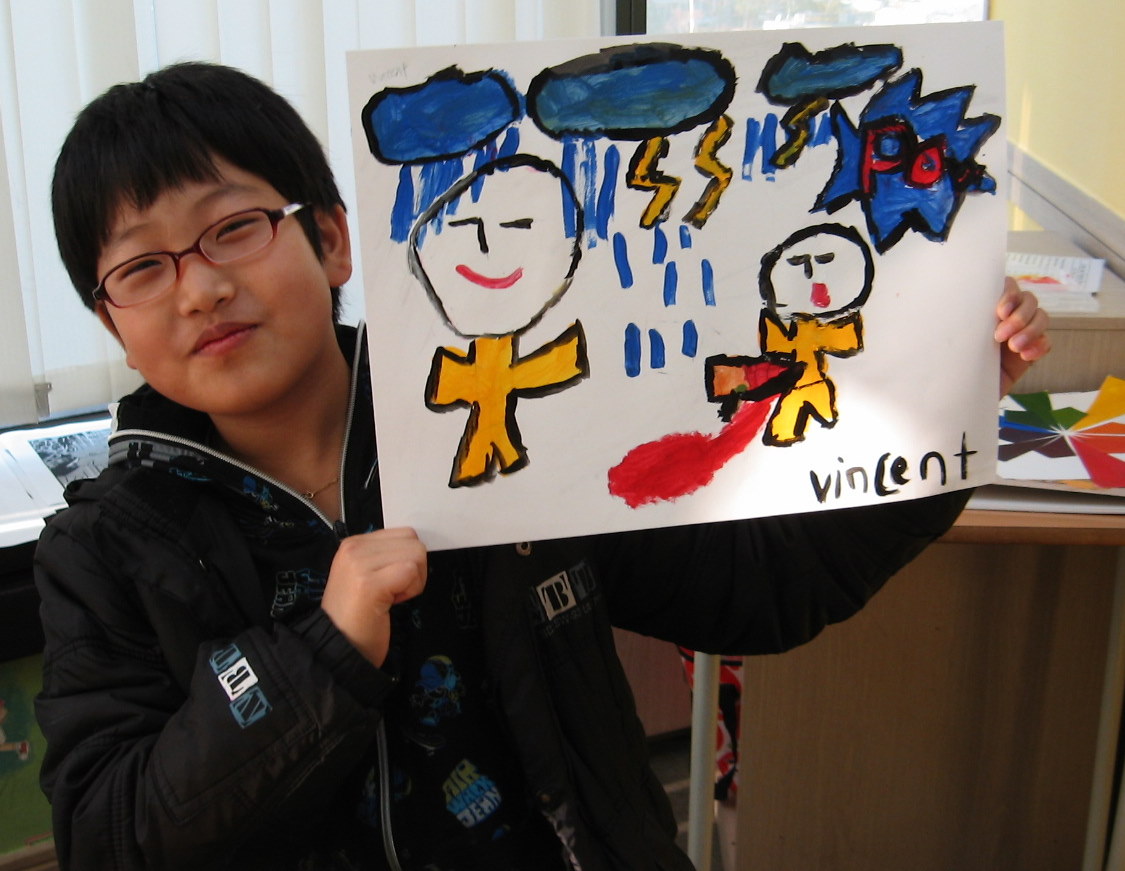
Vincent's Robot


David's Robot with a small "stick man" on top


Aidan's Robot with cape

Students are curious. Parents who come in to pay their bills or to consider the school see the work, and I have been told many have asked about it. Questions like, “Where did they make the art?” “What was the class?” … even the delivery guy checked out the student’s self portraits.

My boss stopped me today, and as she does when she wants to communicate something quickly, she had another teacher tell me how wonderful the art display is, which my director keeps calling “decoration.” I am excited that the artwork is well received. The “Mr. Burns” in the back of my head is steepling his hands and saying, “Excellent, Kimberly … Excellent.” Hopefully soon I will have another class!


Links to art on display:

Comics

Wire sculptures

Artist's Statements

Self-Portraits


Monday, January 24, 2011

A Smiling Waygook: The answer to all your problems

The weekends will often find me sitting in Starbucks. While there are many other, smaller coffee shops that have superior ambiance, where I am less likely to be disturbed by screaming children, for some reason I prefer the ever-changing, noisy crowd of people in Starbucks. Often I create my own atmosphere with my iPod, but occasionally, I enjoy the murmur of couples chatting intimately in Korean, the stray English that floats over to my table, and the laughter or cries of small children.

One crowded morning, as I sat reading, the frustrated cries of a young child jerked my thoughts away from the words on the page. Looking up, I noticed an incredibly cute little girl, probably around 3 years old, trying to get attention from her mother, who was busy with a younger sibling. I smiled and shook my head when I saw her mother immediately jump to attention and attempt to deal with her whining daughter.

The girl continued to whimper about something or other. I assumed it was about a pastry because of the gestures and blubbering accompanying the tears. Her mother talked to her a bit but returned to fussing over the younger sibling. Two children and not enough of mom to go around. The girl’s sobbing continued, varying in volume depending on how much attention she thought she was attracting. Huge crocodile tears streamed down her face, but she was fine. I looked back at my book, but continued to smirk because I understood.

This was not a girl in distress because she had hurt herself. Rather, she wanted attention and knew if she was loud enough, her mother would stop whatever she was doing and come running.

As she continued to throw a mini-tantrum, I saw out of the corner of my eye that her mother had finished with the younger sibling and crouched down to talk to her and give her a hug. The girls sobs continued, though a bit softer than before, so I looked up, again.

The girl saw me, paused for a split-second, then continued to sob and rub her eyes with her fists while staring at me. She was being silly, so I smiled at her.

Suddenly, the crying ceased.

The spigot turned off.

She gave me a half-smile.

Her mother, whose back was toward me was visibly taken aback. I’m sure she thought, “What the hell just happened?” Then the mother saw her daughter looking at something or someone, so she turned around. Obviously surprised to see a waygook (foreigner), she appeared a tad bewildered. We made slight bows to each other in understanding, though the astounded look did not leave her face.

I laughed to myself …

Having trouble with your children? Are they always crying for attention? Do they scream in public and embarrass you? … Find a smiling waygook! They will entertain your children. They will keep your children from driving you crazy. Imagine silent afternoons at home, while your child “studies” English. If you sign up now, we’ll enter you in a lottery for lessons at three of our sister academies and even more time away from your child!

Thursday, January 20, 2011

Art class in Ulsan: Artist's statements


Vincent, Aidan, Jacob, and David

Soon the student's artwork will be on display around the school. I hope to stir enough envy that another art class happens because today was the last day.

Earlier this week, we reviewed all the projects we had worked on: color wheels, comics, self-portraits, collages, wire animal sculptures, and clay robot sculptures. I asked the students to think about their favorite project and write a sentence or two about it. Then they painted their name and wrote their "artist's statement" on a large piece of paper.

Influenced, perhaps, by the hilarity that was wire animal sculptures and wire dung, my students all picked the same "favorite" project.

AIDAN


"My favorite project is animals because animals are funny."

JACOB


"My favorite project is animals because my rabbit is running fast!"

VINCENT


"My favorite project is wire animal because my lion is very interesting."

DAVID


"My favorite project is wire animals because a cat is my favorite animal."