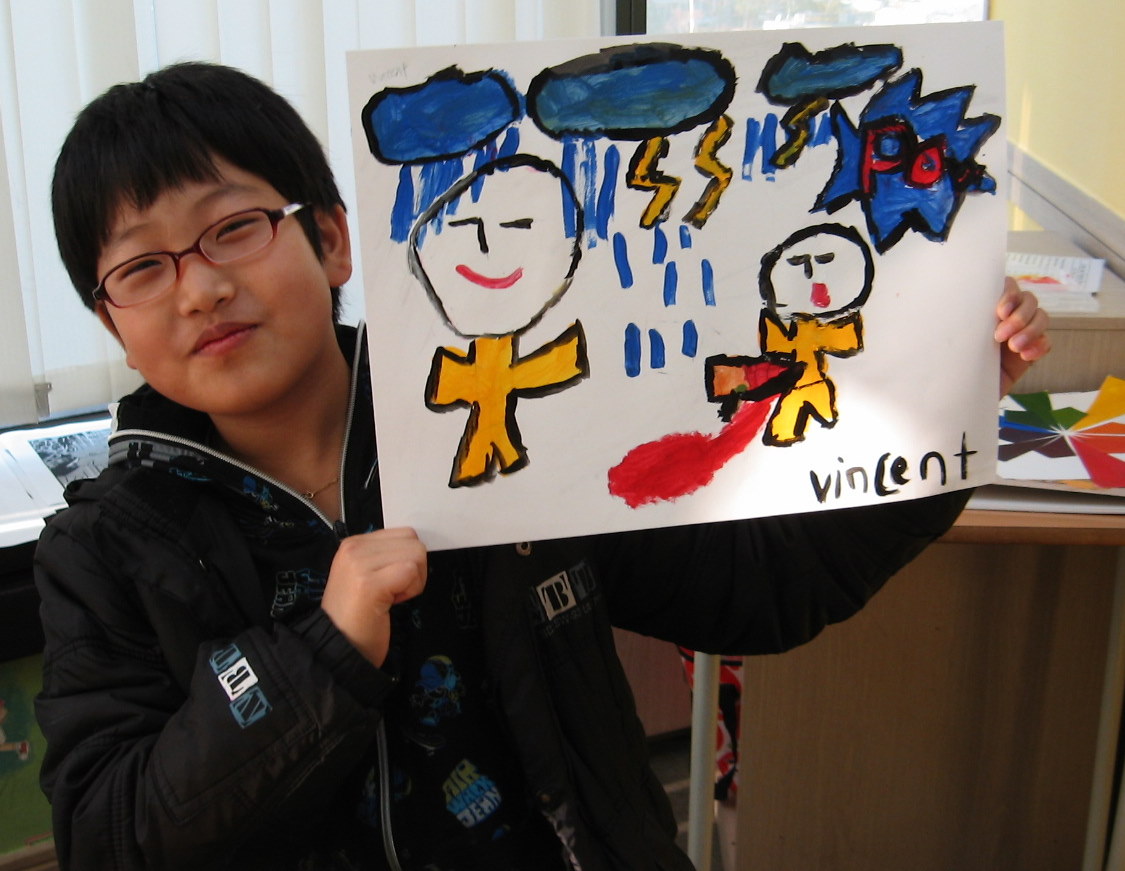
Vincent, Aidan, Jacob, and David
Soon the student's artwork will be on display around the school. I hope to stir enough envy that another art class happens because today was the last day.
In Korea, it is common practice to use English names for students at English academies and in English class at the public schools. Unlike in Russia, where it is a choice of the student who might “Englishize” his or her own name, Kate instead of Katya, for example, the school picks the name.
Usually, the English name has absolutely no relation to their real name. Hye-Lim becomes “Angela.” Su-Bin becomes “Amie.” Occasionally, a student gets lucky and Ji-Oon becomes, “June.”
When I first asked about students having English names, the response was, “Foreigners can’t remember Korean names.”
Um, ok. Way to give us credit.
While, I admit, it might be difficult to do at first, with some effort, any foreigner could learn Korean names. But in an extreme underestimation of the abilities of foreigners, the “easy way out” is given. So, in class, the students use their “English names,” and when you meet a Korean in their twenties who took English, they will introduce themselves with their English name, which is only a first name.
This is all fine and dandy until, as a foreign teacher, you run into something concerning first names and last names.
In English Time, the book series my academy picked out for the foreigner teacher, there is a unit that starts with “What’s your first name?” “What’s your last name?” When I first encountered this, I was unprepared. It was during my first week of classes, when I had absolutely no schedule, so I couldn’t plan my classes.
I stumbled through the lesson.
With role plays, I usually have students change some information, and this one seemed easy. Insert your own name.
The problem I hadn’t anticipated: they only have “first names” in English.
“Teacher, Korean name?!” They asked this in a way that made me feel like they had been threatened NEVER to use their Korean names.
After I thought for two seconds, realized they only had a first name in English, and then said, “Yes, use your Korean name,” a bit of chaos ensued.
The students looked baffled and then, because of the order of their names in Korean, last name first, got even more confused.
I tried to explain group by group, “First name in Korean is last name in the West.”
How confusing is that?!
Finally, it dawned on me.
I wrote my own name on the board, and I got everyone’s attention. Then I said, “Cochrane is my family name. Last name and family name are the same.”
If question marks could appear above heads, they would have.
I repeated, “Cochrane is my family name. My dad is Milton Cochrane. My mom is Debbie Cochrane. My sister is Nichole Cochrane. My brother is Nathan Cochrane … Cochrane is my family name.”
Light bulbs started flickering on.
“In the West we put family names last, so it’s last name. Kimberly is my given name, my first name.”
Overload and the light bulbs went out for most students, but after a bit more work with their Korean names, which they kept trying to tell me their Korean teacher said they couldn’t use, my students finally got it.
Now the question occurs to me, why in the world would a book, made specifically for Korean students, use the words “first name and last name” not “given name and family name or surname” …?
My second encounter with this lesson happened earlier this week, and I was prepared. Before the students even opened their books, we talked about family names.
I had the students tell me their Korean names, and (this is where the story comes full circle) as I attempted to repeat their names with correct pronunciation and intonation, they giggled and insisted I was mispronouncing their names. They had me repeat after them over and over until a classmate asked them to quit, and they shook their heads in disgust.
In the end, it seems English names are preferred by Koreans because they don’t like the way it sounds when a foreigner slaughters their name.
While I loved art, growing up in a small town in Idaho, I had no idea about art museums. I had no idea Idaho even had an art museum. I had no idea that in University I would develop a passion for art history and volunteer at an art museum. And I had absolutely no idea I would teach an art class in Korea.
Luckily, when I was sixteen, the art club took a fieldtrip to the Boise Art Museum (BAM). We were given a brief tour of the current exhibition, and then we sat in front of this painting.
Gregory Grenon, I am Burning, 1994 (BAM permanent collection)
As a group, we discussed questions similar to these:
What colors do you see? Why do you think the artist chose to use the colors he did?
How does the woman in the painting feel? How do the colors help convey this emotion?
How was it painted? (Oil on plexiglass)
The discussion will forever be etched in my mind. During my first exposure to really sitting down and analyzing a work of art, I did what anyone would do as a broken-hearted teenager, I projected my own emotions onto the painting.
After the discussion, we went to the art education room. We each sat by a mirror and worked on self-portraits inspired by the technique Grenon used. Like Grenon, we painted on the back of plexiglass. The whole experience was new for me, and I loved it. I loved my finished self-portrait, and I still have it in the basement of my parents’ house.
So, when I ran into plexiglass at the art supply store while shopping for this art class, I seized the opportunity to have a last minute lesson plan change. I bought the materials. I got a digital image of Gregory Grenon’s portrait to show my students, and I used the whole lesson as I remembered it.
The results are stunning.
Vincent, David, Jacob, Aidan
Jacob
Aidan
MANY THANKS to those who inspired me and developed this lesson plan: Melanie Fales, Shawn Phelps, and Terra Feast.
Amazingly, due to the astonishing Korean ability of inferring what will make you happy (I believe they are just as good at the opposite), I was given the opportunity to have an art class during winter break. The class meets three times a week, for one hour each class, and so far, it has been a blast. Hilarious. Challenging. Fulfilling ... and sooo much fun!
To give the students some footing, because I planned to have them paint quite a bit, our first project was a simple color wheel. Our classroom is at the end of the hall, the furthest classroom from the sink in the bathroom, so when it was time to change the water, I pictured a fiasco. In order to avoid this, I took all four boys, as a group, with their dirty paintbrushes and dirty water in hand and showed them the ropes. How to clean a paintbrush. How to not make a giant mess in the bathroom. And surprisingly, after the first week, I haven't had complaints from anyone about the state of our classroom or the bathroom.
Surprising because the boys are … well … boys.
They do seem to be aware of the fact that I am a bit paranoid about messes. It may be because every time I send one of them to go change the dirty water, I send them with, “Now, be verrry careful. Walk slowly.”
Today at the end of class, when I sent a couple students to clean brushes, while the other two helped me clean the classroom, the students who took the brushes and water came back with nothing.
I paused, looked at them, and asked, “Where are the brushes?”
They looked at me and giggled.
That made me smile, but worry a bit about the state of the bathroom.
I looked at them again, with a half-smile, arms akimbo and said, “What did you do? Where are the brushes?”
Finally, they achieved their goal. They got the other boys, and me, to go to the bathroom with them. The brushes were fine. The sink was nearly spotless. There was no mess. But when we got there, they headed right back to the classroom. Tricky boys, playing on my fear of a mess to get out of carrying the brushes back to the classroom.
What did it teach me?
A) They probably won’t make a mess.
B) They know that I’m afraid they will make a mess. Perceptive little buggers.
C) This may turn into the story of the boy who cried wolf.
...
Ok, Ok.
Enough.
I want to see the art!
After color wheels we worked on a close-up of a comic book frame, inspired by 1950s style comics and a general interest in animation that is expressed by most Korean students. To begin, I showed them black and white print-outs (unfortunately not color) of an action shot of Robin, of a plane crash, and of a close-up by Lichtenstein (my personal inspiration for the project).
Inspiration ... though, keep in mind, without the privilege of a color printer, they only saw them in black and white.
Guidelines: Use bright colors (red, blue, yellow, green, orange). Outline everything in black. And, for action, include a word like "Pow!" "Bang!" "Wham!" "Zing!"
Here are the results:
The finished products
Vincent - Bullet (or torpedo) in the side
Jacob - Fire!
David - Car crash and Zombies
Aidan did not want to pose with his painting, but it is my absolute favorite.