Tuesday, June 7, 2016

In Cold Water: A Tale of Dinghy Sailing with Unfamiliar Crew


"Ready to jibe?"

“Ready.”

Suddenly, the mainsail, which I had successfully trimmed in for the jibe was headed straight for the water and fast. I had no time to counter the weight of the wind in the sail with my body, being caught off guard at my botched jibe and the weight of my crew on the leeward side. Before I could think twice, I was in the water, swimming around the boat and toward the dagger board. My crew was hanging onto the mast, so as I reached for the dagger board which had not been locked into place, the boat went from a simple capsize to a full turtle. My crew was nowhere to be seen.


As I stood on the edge of the hull, dagger board fully extended now, I shook my head and hoped like hell that my crew could swim. I waited for her to surface, and reflected on how I got myself into this situation.

Earlier in the day, I had rented a Laser 2000 with a novice sailor. It’s not that I am all that experienced myself. I have been sailing for two years, mostly in summer, and I have hopped between Picos (small dinghies) and keel boats. Except for my experience on the Picos and my lessons with the keel, I have not been skipper much. I’m still learning how to identify the wind while sailing, and this is what gets me in trouble.

My rental earlier in the day was to gain experience, and experiment as skipper. After lunch, my English speaking crew from the morning headed off to her prior engagements, and I assumed that I would just be crew for another novice skipper, or I would gain some knowledge from the coach would was helping show us the Laser 2000s.

I was wrong.

As we headed back out toward the boats, one of the novice sailors, the only other woman left in the group, grabbed my arm and insisted that she ride with me. I tried to express that I just wanted to be crew, maybe she could be skipper. I received a very emphatic, “No.” So, there I was, heading back out, a little worse for wear, having woken up at 5:30 that morning to catch a bus.

As we left the safety of the beach, things didn’t seem so bad, except that I was having a hard time catching this wind, which was supposedly right behind us. The wind seemed to be shifting, but it is quite possible that my perception was off from the beginning.

We made it out to bigger water, and we tried some exercises, my crew, whose English was as limited as my Korean, insisted that we fly the jib. I asked her to hold off a bit. I wanted to get my sea legs before adding more power. Finally, her nagging won out, and we were flying the small jib. 

“Ready to tack?”

“Ready.”
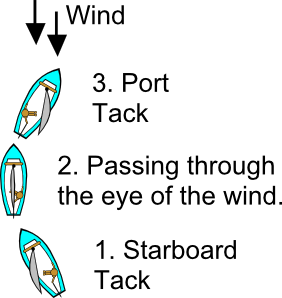
Tack Diagram (sailing) Clip Art

Some tacks were better than others, in many I lost speed before the tack for a myriad reasons. Finally, we started working better together. We, being me and the boat, or me and my crew, or all of us all together. I was feeling confident, and I was practicing maneuvering as much as possible. I had to get my sea legs as I was competing in my first ever dinghy regatta the following weekend.
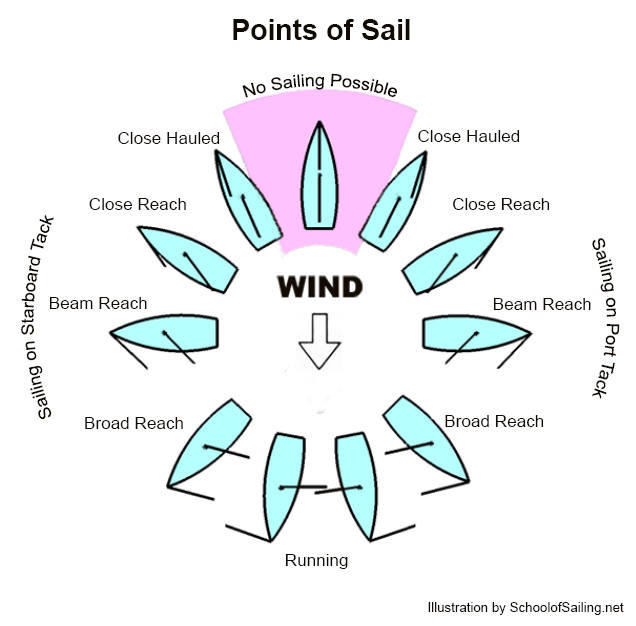

As we sailed downwind, at a broad reach on a port tack, I felt pretty good about our position. The sail was out, we were flying, catching waves and surfing occasionally. Then, I decided it was time 
for a jibe.

As I attempted the jibe, something went horribly wrong. We caught a strong gust. The mainsail and my crew headed straight for the water.
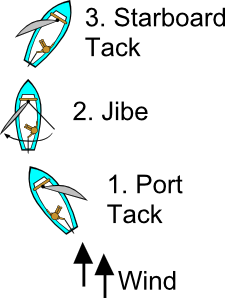


I had begun to contemplate the possibility of my crew not surfacing, when I finally saw her. She did not look happy. The first thing she said to me was she was cold. I started immediately insisting that she come help me right the boat. I knew what we had to do, and I knew we could do it. She refused. She would not move from her current position. She shook her head stubbornly, frowned, and held tightly onto the bowsprit.

I started looking around. Standing on the edge of the hull, without it leaning even a bit, I knew it was hopeless for me to attempt this situation alone.

In the distance I saw the jet ski of the marina coming toward us. As it approached, I imagined my crew being lifted away onto the jet ski and carted back to the mainland. The way she was acting, I had started imagining that she was near hypothermia or had been badly injured.

As the jet ski approached, she reached out for it. Hoping to be carted away. Instead, one of the men on the jet ski jumped off and started trying to help my right our boat.

We pushed against the hull with our feet and used the dagger board as leverage. This boat did not want to budge, and it took a long time for us to even get her to a properly capsized position. Finally, we righted the boat, and my first move was to make sure we didn’t capsize again. As she tilted back toward the water, I jumped on the opposite side of the hull and grabbed to uncleat the mainsheet, setting the mainsail free.** I also took the opportunity to furl the jib. As far as I was concerned we would not be needing that bit of power anymore.

I boarded the boat to the best of my ability, but I found that jumping back into a boat after a capsize took the last remaining bit of energy I had. The man who helped right the boat, pulled me in by my life vest.

With my crew being cold and seemingly helpless in the water, as she back-floated over to the rear of the boat, I made the decision to head in. When she insisted that we go back out, I refused.

We headed slowly back in, and I called it a day.


**The cleated mainsail was much of the reason the Laser 2000 was extremely difficult to right as it added additional drag.


Luckily I went out the next weekend with crew I was familiar with. We maneuvered in low, shifting wind and came out sixth place out of eleven teams in the regatta.

Tuesday, March 22, 2016

The Zoo in My Basement OR What Makes a Story**

I liked to tell stories. Stories that people would believe. Stories that others would help me construct as I gauged their reactions. In my book, I was not a liar. 

I lay on the bottom bunk in my friend’s room staring up at the bars that held his mattress in place. I shifted my attention to the dark blue flannel sheets which covered me. The stars on them nearly glowed as they reflected the night light.

My friend’s mom had told us to be quiet and go to sleep, but I was not ready for sleep. As I took in the smell of a foreign detergent on the sheets, I thought about my sheets at home, the cotton and polyester blend which was so much cooler and smoother than these, and I waited for the right moment to speak.

Thinking about the mystery that lay hidden in that basement, I could not hold it in any longer.

“Hey, are you still awake?”

“Yes.”

“I was just thinking about the basement of Room 10.”

Sometimes we would use Room 10 as a shortcut to the yard at the back of the Motel. I knew my friend had seen the dusty, wooden stairs leading to a dark void, but he probably had never ventured down them.

Usually accompanied by my father, I had. 

“There’s a secret room in the basement. It has an orange light.”

So far, I had not strayed from truth. The steep, cobwebbed stairs led to a room filled with gas-lit furnaces and water heaters. The room smelled industrial, like steel pipes mixed with water and heat. Near the bottom of the stairs was a shelf which organized the letters for the motel sign. Usually, that was as far into the basement as I got, grabbing letters for the sign. But earlier that week, I had seen more.

I found a cellar or bomb shelter, an ill-lit, hidden compartment in the basement. This hidden room got my imagination churning. What was it for? Why was it there?

“A secret room?”

“Yeah. We have animals in there.”

“Really?”

I could hear by the tone in his voice that I had his interest, but he did not quite believe me.

“What kind of animals?”

“There’s a pony.”

I always wanted a pony when I was a child, so it made sense to start there.

“A pony?”

“Yeah, it’s a really big room. So big, I couldn’t see the end of it. There’s a pony and a couple horses.”

“What else is there?”

This time, I felt I was losing him. Horses? Ponies? This was a boy I was talking to, and his tone told me that he was not going to be that interested unless I upped the danger factor.

“There’s a gorilla.”

“A gorilla?! What? Wow!”

Now I had him, and as I continued to craft my underground zoo, I envisioned it in my head.

“Yes, a gorilla. And …” picturing what I knew about the jungle and wild animals, “And, a lion.”

“A lion? Wouldn’t he eat all the other animals?”

“No. It’s like a zoo. All the animals are kept separate. The zebras are together. The giraffe is …”

“There’s a giraffe?!” Neither of us had ever seen a giraffe. Our local zoo did not have them. Even the large zoo in the closest major city only had one, and it was mostly kept out of view.

Now, I had gone almost too far with the story. I had captivated him with details that begged to be shown off. I should have predicted what would come next.

“I want to see it! I want to go to the zoo in the basement of the Motel! Can you show me? Can we play with the animals?”

My friend raised his volume to a point where I almost shushed him. I was afraid his mom would come in. She was not the kind of mom you wanted to come in to tell you a second time to be quiet. Her stern voice always made me feel guilty before I could even process what I had done wrong. Thinking quickly, to avoid ruining my storytelling experiment, I countered his proposal with the end of my story.

“You can’t visit the zoo because the animals aren’t there anymore. There was a big flood in the basement …” I had heard of basements flooding, but I had never seen such an event. “Anyway, all the animals had to be moved out. Now there’s just a big empty room. No more animals. No more zoo.”

“Oh man.” Even in his disappointment, I could tell that his mind was still buzzing with the questions, the plausibility of this story.

As we both fell asleep that night, my friend probably dreaming of an underground zoo, I reveled in the satisfaction of a story well told. While I had walked close to the line, he had not once called me out and said I was telling a story. He believed my story, and this meant I had done a good job.

I firmly believed that a good story came from a captive audience, one which could give feedback about the believability of my stories. This kind of feedback only came from an audience which did not know if I was telling a story or not, I never told my listeners I was telling a story. That would take away the spark of imagination, the excitement of possibility, the line between believable and not.

The next week would show that the adults in our lives did not think this way. To his mom, I was a liar, spinning unbelievable tales and taking advantage of the goal-ability of her child. I was a liability. If I could tell this kind of a lie, what was next? I can only imagine the conversation which occurred between my mother and her.

Afterwards, at home, my mom asked, “Did you tell your friend that there used to be a zoo in the basement?”

“Yes, but it was a story.”

“He didn’t know it was a story. If people don’t know you are telling a story, it’s a lie.”

“But, if people know it’s a story, it’s not as fun to tell.”

This was not the last story I told. The next time my mother was much more firm, and I stopped telling fictional stories for good.


**As a note about this story. I do not remember the exact dialog or layout of my friend’s room. Some details may have been extracted from other memories or embellished to tell a better story. Please do not think this makes me a liar.

Sunday, March 13, 2016

The Pink Piano OR Accepting Gifts from Strangers

I often wondered where my street smarts came from. I grew up in a small town, where people did not lock their doors, a place where it was okay to leave keys in the ignition and the door of the vehicle wide open. (Yes, my father did just that.) 

I grew up in a time when children went door to door on Halloween asking strangers / neighbors for candy.

Everyone in my life was trusting, and nothing bad ever happened.

So, when I moved to a big city, how did I instinctively know not to make eye contact with a ranting stranger on the street, subway, or bus?

How did I know to buy purses with over the shoulder straps and ensure that all important zippers faced in?

How did I know that it’s best to just “look like you know where you are going” even if you are lost? 

Was I just born paranoid?

Perhaps.

But as I started to reflect on stories of the motel from my childhood, I realized, most of my street smarts came from being raised in the manager’s apartment of a motel on the south end of a small town called Blackfoot, Idaho.

When I was in kindergarten, school only went for a half day. The other half of the day, I spent with my father or hanging out alone. I would help my dad clean rooms. I would walk around the parking lot and pick up cigarette butts, a penny a piece. I would wander around the back yard, inventing stories and going on adventures. I would watch my dad fix the pickup, van, or a sink. I would try to help him install a toilet in a room under renovation.

Not matter where we were around the motel, people would chat with my dad about their room or life or money situation. Everyone knew I was the manager’s daughter. If I was out in the parking lot without my dad, people would ask,

“Have you seen M___?” 

“Hey, is your dad around?”

My parents taught me very early, not to talk to strangers, not to engage. Being shy by nature, this was not a difficult thing for me to grasp. I got it. If you see a customer coming, avoid them at all costs, never answer the office door, and as I learned, one day, never take gifts from customers.

In the comfort of our home or in the backyard, no one bothered me, unless I walked past the back windows of their rooms.

One day, I was walking around the backyard, heading down the alley toward the “back back” yard, under the windows of a few of the rooms. Unexpectedly, a tenant, one of the weekly renters who was fairly new, called to me from his window.

Now, due to the nature of the arrangement, me, a small child, and the window rather far up, I did not feel like I was in any immediate danger. I knew I was breaking the rules, but it did not feel dangerous. This renter was a stranger, but we were separated by a large amount of space. He was just trying to make friendly conversation.

So, despite all warnings, this stranger was able to engage me in conversation. As I remember it, it was a fairly harmless conversation about what I was doing and if I liked music, and it ended with him handing me a little pink keyboard out the window of his room. I took the piano. Thanked him and went back inside to play with my new toy.

The problem came when my parents noticed this toy.

“Where did you get that?” My mom asked.

“The man in number 5 gave it to me.”

“What?”

“I was just walking to the back, back yard, and he gave it to me through the window.”

I remember that my mother was furious. Perhaps she was embarrassed, but more than likely she was worried or scared. My mom, never fond of raising children around an ever-changing group of wayward travelers, had thoughts of child abduction or molestation.

“You cannot keep that. Do not take gifts from the people staying here. You should not trust them.”

I was confused and scared, as she lectured me about the danger I had put myself in. As at all times in my life when emotions reach a peak, I started crying. I just wanted to keep that pink piano. I had no idea that I had put myself in danger. The man did not seem scary, and there had been a wall between us. I did not think I had done anything wrong.

“And never talk to anyone from the backyard. Just ignore them or tell your dad.”

My parents gave the piano back. I have no idea what words were exchanged, but I do not remember ever being bothered by that tenant again.

I do remember being nervous about passing under those windows. I do remember hurrying because I did not want strangers watching. I do remember being scared of any interaction with a tenant. And when I was old enough that I started cleaning rooms, I remember I would always clean the rooms I knew people had left first. 

I never accepted a gift from a stranger at the motel again.

I also gained my first real taste of street smarts.

Monday, March 7, 2016

Your face will get stuck like that OR A girl named Kim

As a young child, watching Bugs Bunny dig to China, presumably through the center of the Earth, and come out on the “other side”, got my thoughts churning.

I am a bit of a loner. I enjoy sitting alone, thinking to myself, musing about the events around me, watching people. As a child, these observations were budding, my musings simple. 

"What does it mean that Bugs Bunny changed when he came out on the “other side.” Was he still Bugs Bunny?"

Perhaps, it wasn’t actually Bugs Bunny. It is impossible to travel through the center of the Earth. Maybe it was Bugs Bunny’s doppelganger.

If it was, maybe I had a look-alike on the other side of the world, too. A girl named Kim who was exactly like me, the same age, the same interests, the same basic person, only, this Kim had almond-shaped eyes.

Sitting alone, in front of the bathroom mirror, mulling over these ideas, I decided I wanted to have almond-shaped eyes. I thought they would be more beautiful than my round eyes.

Suddenly, an idea popped into my head.

My dad had a way of getting us to stop pouting or throwing a fit, or at least trying to get us to stop.

“Make that face long enough, and your face will get stuck like that.”

Rationally, I may have known this was not entirely true.

The statement should have gotten the same “Daa-aad” response that, “If you stick your lip out far enough, a bird will come sit on it,” did.

But.

Take this concept that a face could get stuck a certain way, and apply it to the idea that I wanted almond-shaped eyes.

The result?

I sat in the bathroom for what amounted to be hours, holding the outer corners of my eyes, trying to get my eyes to “get stuck like that.”

Slowly the realization came that there was no way my face was going to get “stuck”. It became obvious that it was improbable that suddenly I would have almond-shaped eyes just because I wished for them.

Little did I know that in this thought, this wanting to have an eye shape that I did not have, I unknowingly had found the key to what in the future turned out to be “a girl named Kim who was like me.”

Fast forward to my life in Ulsan, South Korea, an industrial city where having cosmetic surgery is the norm and never having had cosmetic surgery makes you an outlier.

Here, I am constantly complimented on my small face and big eyes. Both of these things are thanks to my heritage, and the fact that holding out the corners of your eyes does not change their shape, no matter how determined you are.

In Ulsan, girls are not just holding their faces in a shape hoping their faces will get stuck. In Ulsan, I am surrounded by plastic surgery eyes, by shaved jawlines and “high” noses.

You would think that simply being surrounded by all this plastic would have reminded me of my brief, childhood dream of having almond-shaped eyes, but it wasn’t until winter vacation when a coworker of mine got double eyelid surgery, that I started remembering.

First it was the idea of changing eye shape, and then it looped back to “that girl named Kim who is exactly like me, but she lives on the other side of the world.” If by Kim, I meant a family name, and by exactly like me, I meant wanted to look differently than she did, then I found her. 

In Korea.

As an adult.

Transforming her eyes to look more like mine.